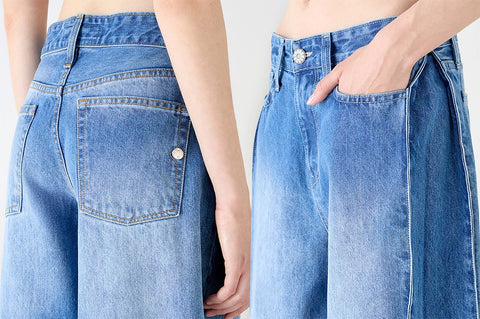
When it comes to denim, the fabric’s weight is much more than just a technical specification: it defines a garment’s character, the way it drapes on the body, and how it feels every day. “Ounces,” abbreviated as oz, are the unit of measurement used to classify denim weight: 1 oz equals 28.35 grams per square yard of fabric.
Understanding this value means consciously choosing not just a pair of jeans, but a fit experience.
Lightweight denim: 4–6 oz
Lighter-weight denim, ranging from 4 to 6 oz, is more similar to shirting fabric than to traditional denim. It is fluid, soft, extremely comfortable, and ideal for unstructured garments.
This is the case with our Denim Silk, a distinctive fabric we use to create pieces like the Flaire Smocking, Polly, Mina, and Sissy Capri Pants, as well as our lightweight and versatile Chambray, which is the star of styles such as the Graff Jumpsuit, Erre Shirt, Polo Shirt, Bubble, Vivi Blouse, and LM Dress.
These weights are perfect for the warmer seasons or for anyone looking for denim with a refined, barely-there hand.

All-Season Denim: 9/12 oz
Denim in the 9 to 12-oz range strikes the perfect balance: fabrics designed to be worn year-round, with a structure that provides support without feeling heavy.
Our 9 oz Stretch Denim, one of our iconic fabrics, was created with exactly this purpose in mind. It’s the fabric we used to introduce the Flaire Jeans: comfortable, versatile, and designed to move naturally with the body.
Alongside this, Japan Denim—with its all-season weight—offers a more authentic and textured take on denim, used in styles such as the Five, Jacket Perlage, and Twilly.
These fabrics combine everyday practicality with impeccable aesthetics.
Heavyweight denim: 14 oz and up
When the weight exceeds 14 oz, denim takes on a more structured and bold character. These are dense, durable fabrics, designed to stand the test of time and evolve with the wearer.
Our Patriot Denim, used in styles such as Franz, Berry, and Arch, fully embodies this philosophy, as does our Denim Cross, which we use to create iconic pieces like the Matthew Bomber.
At first, they may feel a bit stiffer, but it is precisely this quality that makes them unique: they mold themselves over time, developing character and personality.
To give you an idea of how much weight can affect denim, there’s an interesting record: the world’s heaviest pair of jeans weighs 33 oz. So stiff that they can stand on their own, they’re nicknamed “leg breaking” because, quite literally, they “break your legs.”
Choosing the right denim weight means deciding how a garment should feel: light and flowing, balanced and casual, or structured and bold.
For us, every fabric weight is the result of meticulous research, conducted entirely in Italy, where materials, craftsmanship, and design come together to create garments that don’t simply follow the seasons, but embody an authentic and enduring style.