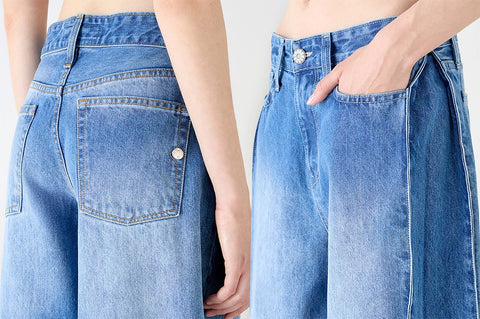
Choosing the right jeans means, first and foremost, reading your proportions. The rise, construction, and volume do not only define the fit, but also visually alter the relationship between the torso and legs. This is where the vertical body proportions comes into play, an interesting key to understanding denim.
Two people of the same height and size, in fact, have very different proportions. The vertical body proportions describes exactly how the figure is visually distributed between the torso and legs and can be high, medium, or low.
If we are used to choosing jeans based on the fit — skinny, straight, flare, wide, baggy — there is another element to consider: the rise, or the height of the crotch and the point at which the jeans sit on the torso. High, mid, and low rises can significantly change the perception of the silhouette, visually shifting the point where the legs begin.

Those with a high vertical body proportions tend to have visually long legs and a shorter torso. A high rise accentuates this feature, as in the case of Flaire, while a mid rise can better balance the proportions. Mariella and Berry, for example, slightly lower the visual starting point of the leg, giving more space to the torso.
With a medium vertical body proportions, however, the torso and legs are naturally balanced, and the choice of rise becomes primarily a question of silhouette. A high rise like that of Milly emphasizes the waist and visually elongates the legs; a mid rise like the Five maintains a more natural result, while a lower rise, especially when combined with loose and baggy fits like Franz, draws attention to the hips and gives the look a more relaxed attitude.
With a low vertical body proportions, the torso appears longer than the legs. A high rise can then shift the perceived starting point of the leg upwards and elongate the figure, especially when paired with a straight or wide construction and generous lengths. Milly, Billy, Polly, and Flaire work well with this type of proportion. A low rise, on the other hand, has the opposite effect, visually elongating the torso: not a rule to avoid, but a deliberate choice that can be interpreted through lengths, shoes, and styling.
Understanding your vertical body proportions is simpler than it seems. Just observe the relationship between your torso, waistline, and leg length in front of a mirror, preferably with your natural waist visible. Predominant legs and a shorter torso suggest a high center of gravity; similar proportions between the two parts indicate a medium center of gravity; a visually longer torso suggests a low center of gravity.
Trying the same type of jeans in low, mid, and high-rise versions can make the difference even more evident. Rather than asking which one “looks better,” it is interesting to observe how the silhouette changes.
Because talking about proportions does not mean correcting or hiding the body, but rather better understanding the tools that denim has to offer. The right jeans do not necessarily follow a universal rule: they allow you to choose which proportions to emphasize and what story to tell.